Designing future mobility services with embedded public value
Halmstad university in collaboration with Halmstad municipality, Service-designer, 2021
It is projected that by the year 2050, the number of urban residents will increase by 68 per cent (United Nations, 2018). This increase brings issues such as congestion in cities and limited parking spaces, especially for private cars. With global warming and increasing heat waves coupled with the challenges of managing a pandemic, Mobility-as-a-Service (MaaS) becomes an area of complex sustainable and development challenge. The Sustainable Developments Goals (SDGs), also refer to making cities more inclusive and sustainable (SDG11), in particular, target 11.2 defines that by 2030, governments should provide access to safe, affordable and sustainable transport systems for all. This formed the basis of our research design project as part of the OSmaaS (Synergie of mobility as a service) project at Halmstad University, Sweden.
How can future mobility services be designed to embed public value?
The project
During a four month long design project, we were tasked with exploring and designing solutions for future mobility problems and opportunities. The idea was to focus on the future and add elements that we wanted to build a future world where the living conditions differ from now. We were three students, two with design degree’s and a third with a business degree. The team consisted of Emil Bergström, Maryam Baduna and Christian Loney. The design project was in collaboration with Halmstad University and presented to the OSmaaS members.
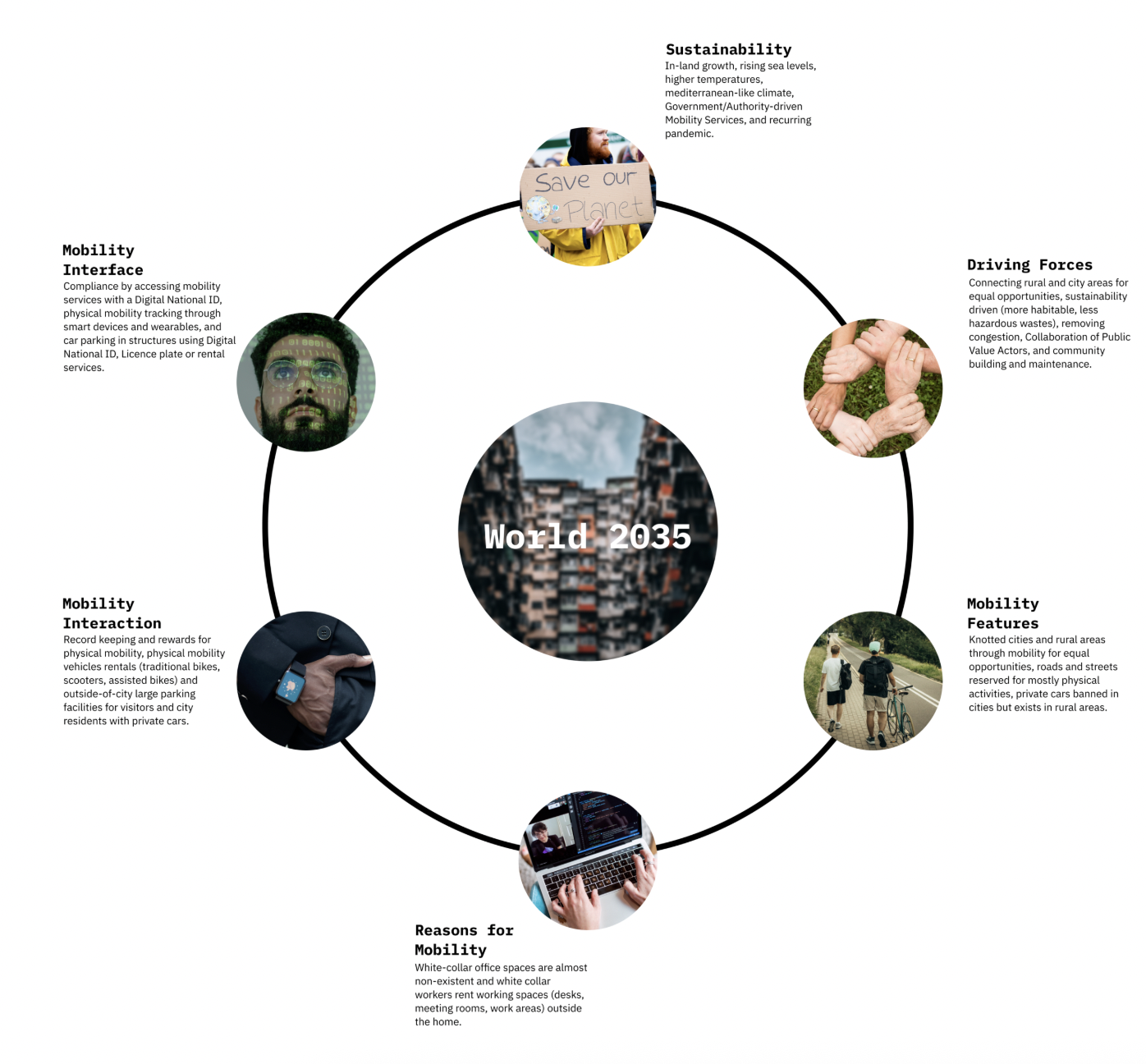
To design for the future we got to imagine a future
One of the more complex aspects of this project was designing for a possible future. This was intentional, as it allowed us to explore more innovative possibilities. The future we envisioned wasn’t far-fetched or purely imaginary, but rather a realistic scenario that could plausibly happen soon.
Design process
While I officially had the role as a UX Designer, I stepped in as an informal project lead to drive the process forward. I structured the work around a design thinking approach, ensuring solutions were rooted in real user needs.
Exploring Public Values
Interviews with private and public actors
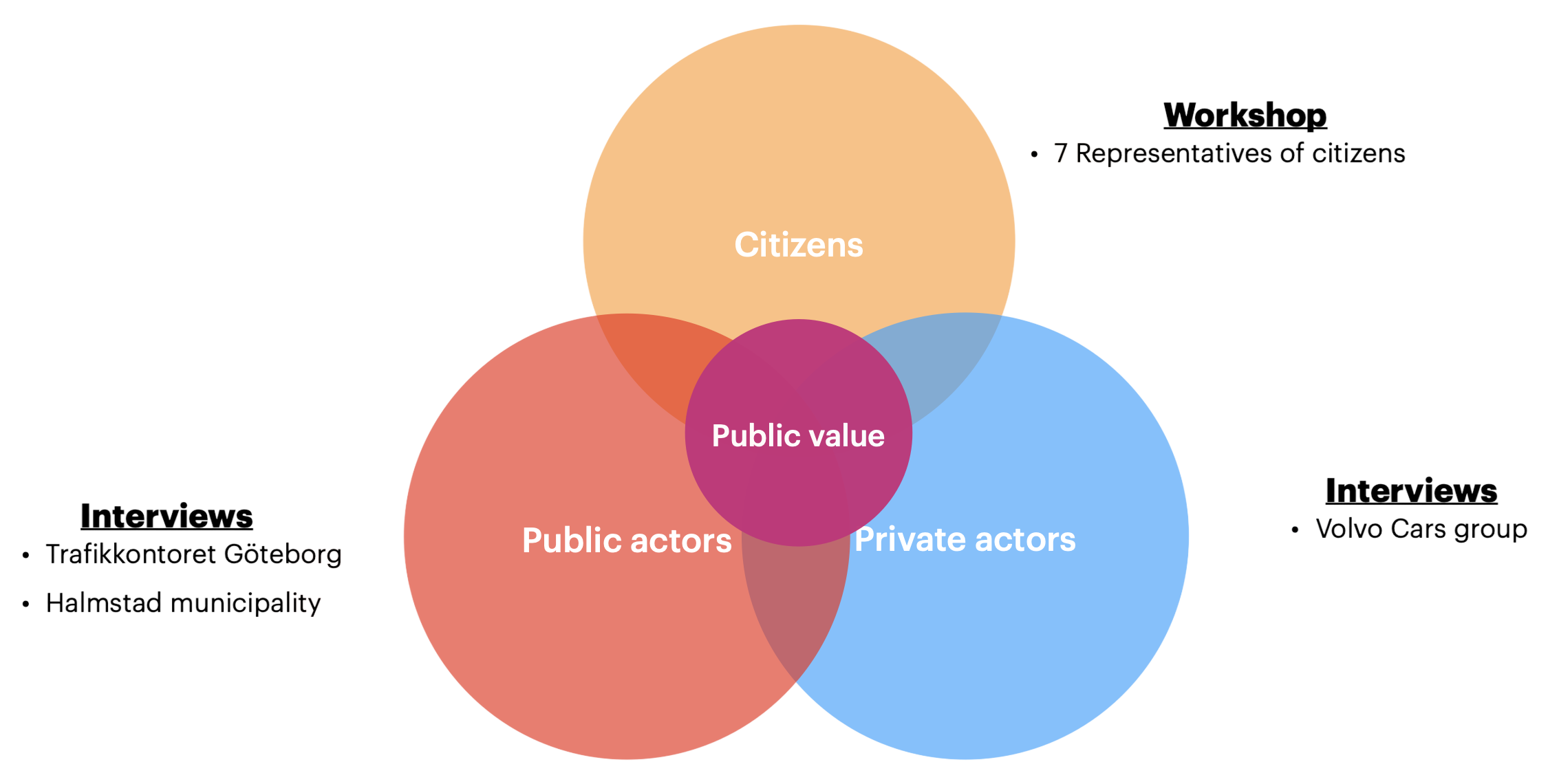
The purpose of the interviews was to investigate public and private actors' current situation, how they work with mobility and public value. To better understand how the collaboration looks between public value actors, how they look at future mobility, and what barriers they face. To use this empirical data in consideration when designing for future mobility as an essential design factor. All interviews were performed over Zoom in COVID-19 times.
Workshop with Citizens
The workshop's goal was to get an insight into the current mobility situation from the citizens perspective, to grasp future forms of mobility, trying to go beyond the existing instances of transportation. We wanted to discuss what makes the citizens move and what barriers there are and what reasons and motivations that lay behind this. The workshop's content was then later used to explore how future mobility services can be designed to embed public value.
Outcomes
The Public Value Service Canvas
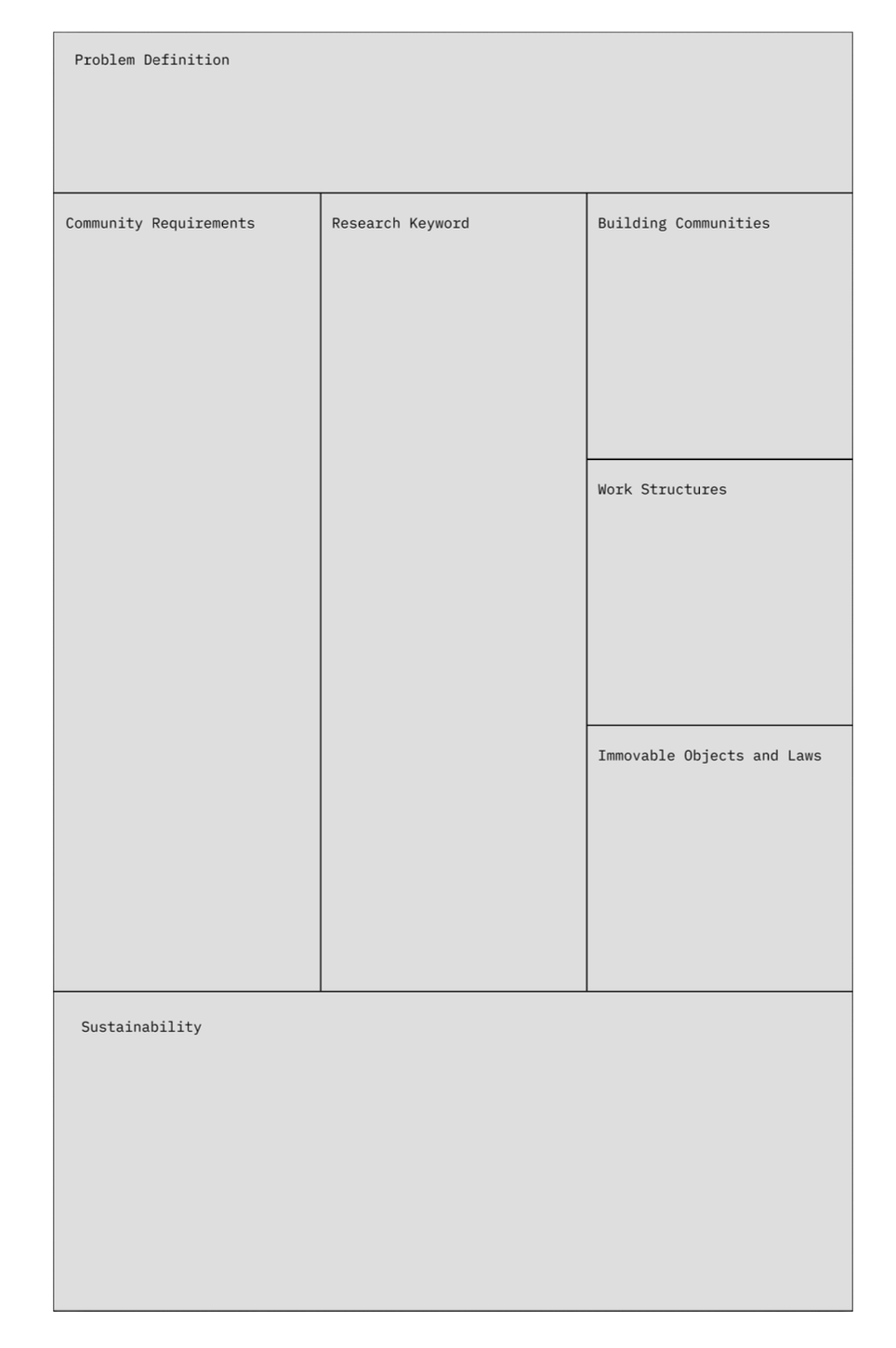
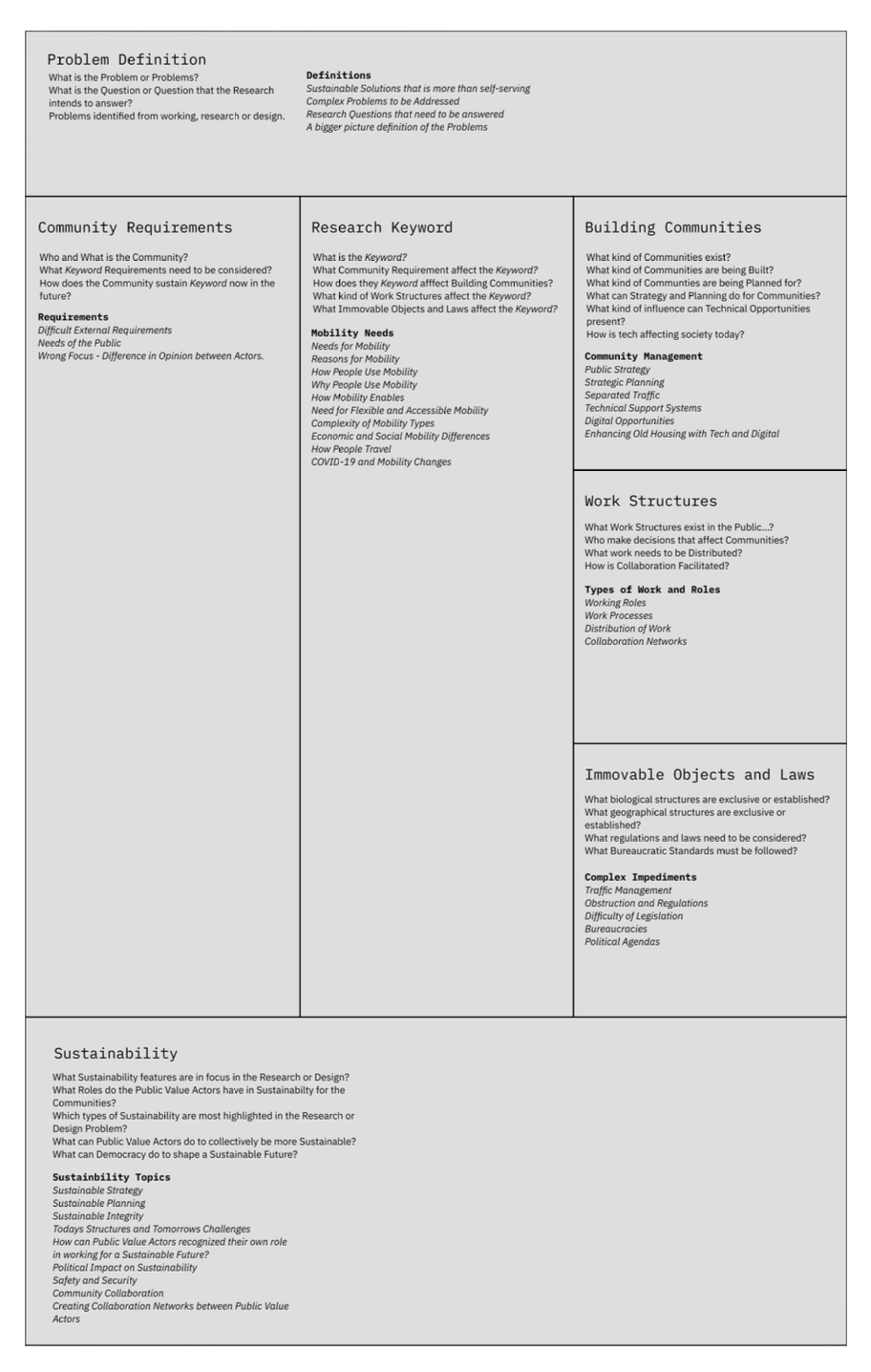
The Public Value Service Canvas intends to assist designers and researchers in uncovering and exploring public values and what is needed to achieve it. It is also meant to help discover relationships within the stakeholder group such as Public Actors, Private Actors and Citizens. These three types of stakeholders all have different value systems and reasoning. Designing services for the three actors simultaneously is a large and complex effort which requires designers to prioritize different types of values for each stakeholder.
The Public Value Service Canvas content intends to facilitate the design process to embed public value into future mobility services. The Public Value Canvas does this through partly being built through empirical data collection and analysis that the designer or researcher performs. Also, by using empirical data from relevant problem domains by communicating with the Public value Actors.

A prototype
The digital mobility service prototype is a service concept based on public values represented through opportunities identified during the design process. With interpreted data from the empirical data analysis, the public values made it possible for us to create opportunities to form a more tangible design proposal for a future mobility service. The service prototype was based on 7 identified Service Goals.
- Empower and inform communities through digital services
- Enable people to make better mobility decisions
- Safety and security
- Local and national sense of community
- Pandemic or crisis management
- Personalized experiences
- Provide a better journey experience
Want to know more?


Designing future mobility services with embedded public value
Halmstad university in collaboration with Halmstad municipality, Service-designer, 2021
It is projected that by the year 2050, the number of urban residents will increase by 68 per cent (United Nations, 2018). This increase brings issues such as congestion in cities and limited parking spaces, especially for private cars. With global warming and increasing heat waves coupled with the challenges of managing a pandemic, Mobility-as-a-Service (MaaS) becomes an area of complex sustainable and development challenge. The Sustainable Developments Goals (SDGs), also refer to making cities more inclusive and sustainable (SDG11), in particular, target 11.2 defines that by 2030, governments should provide access to safe, affordable and sustainable transport systems for all. This formed the basis of our research design project as part of the OSmaaS (Synergie of mobility as a service) project at Halmstad University, Sweden.
How can future mobility services be designed to embed public value?
The project
During a four month long design project, we were tasked with exploring and designing solutions for future mobility problems and opportunities. The idea was to focus on the future and add elements that we wanted to build a future world where the living conditions differ from now. We were three students, two with design degree’s and a third with a business degree. The team consisted of Emil Bergström, Maryam Baduna and Christian Loney. The design project was in collaboration with Halmstad University and presented to the OSmaaS members.
To design for the future we got to imagine a future
One of the more complex aspects of this project was designing for a possible future. This was intentional, as it allowed us to explore more innovative possibilities. The future we envisioned wasn’t far-fetched or purely imaginary, but rather a realistic scenario that could plausibly happen soon.
Design process
While I officially had the role as a UX Designer, I stepped in as an informal project lead to drive the process forward. I structured the work around a design thinking approach, ensuring solutions were rooted in real user needs.
Exploring Public Values
Interviews with private and public actors
The purpose of the interviews was to investigate public and private actors' current situation, how they work with mobility and public value. To better understand how the collaboration looks between public value actors, how they look at future mobility, and what barriers they face. To use this empirical data in consideration when designing for future mobility as an essential design factor. All interviews were performed over Zoom in COVID-19 times.
Workshop with Citizens
The workshop's goal was to get an insight into the current mobility situation from the citizens perspective, to grasp future forms of mobility, trying to go beyond the existing instances of transportation. We wanted to discuss what makes the citizens move and what barriers there are and what reasons and motivations that lay behind this. The workshop's content was then later used to explore how future mobility services can be designed to embed public value.
Outcomes
The Public Value Service Canvas
The Public Value Service Canvas intends to assist designers and researchers in uncovering and exploring public values and what is needed to achieve it. It is also meant to help discover relationships within the stakeholder group such as Public Actors, Private Actors and Citizens. These three types of stakeholders all have different value systems and reasoning. Designing services for the three actors simultaneously is a large and complex effort which requires designers to prioritize different types of values for each stakeholder.
The Public Value Service Canvas content intends to facilitate the design process to embed public value into future mobility services. The Public Value Canvas does this through partly being built through empirical data collection and analysis that the designer or researcher performs. Also, by using empirical data from relevant problem domains by communicating with the Public value Actors.

A prototype
The digital mobility service prototype is a service concept based on public values represented through opportunities identified during the design process. With interpreted data from the empirical data analysis, the public values made it possible for us to create opportunities to form a more tangible design proposal for a future mobility service. The service prototype was based on 7 identified Service Goals.
- Empower and inform communities through digital services
- Enable people to make better mobility decisions
- Safety and security
- Local and national sense of community
- Pandemic or crisis management
- Personalized experiences
- Provide a better journey experience
Want to know more?

